
Quick Answer
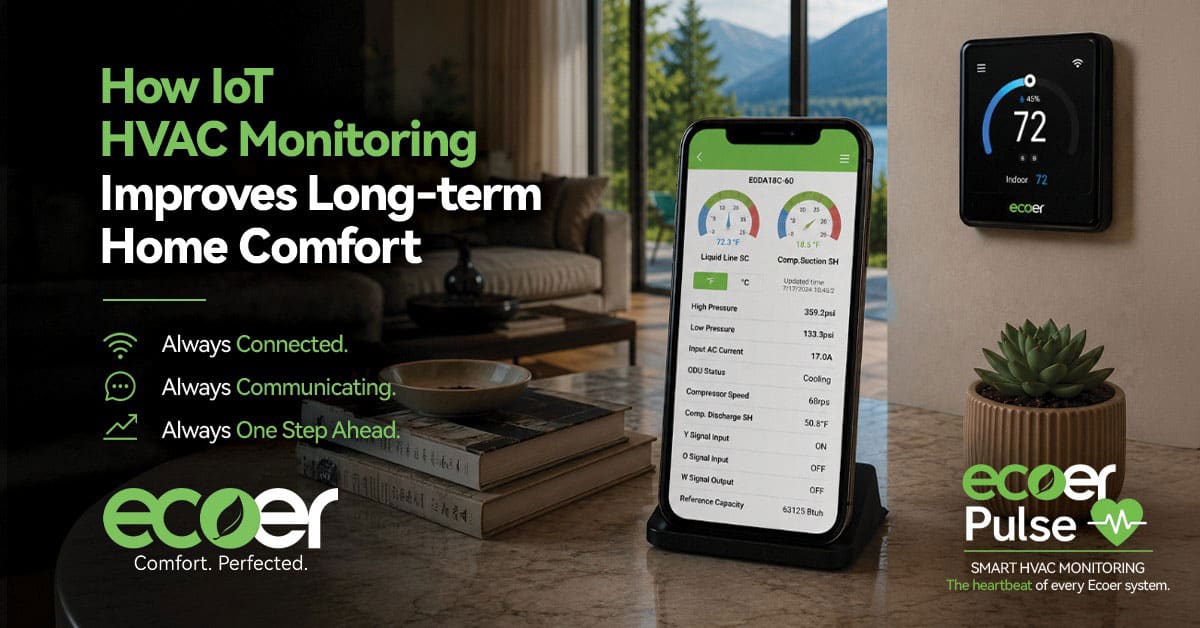
IoT HVAC monitoring uses connected sensors and software to continuously track how a heating and cooling system is operating. Instead of relying only on periodic service visits or waiting for a homeowner to notice a problem, connected systems can provide contractors with ongoing performance information that supports faster diagnostics and more proactive maintenance.
For homeowners, that can mean more consistent comfort and greater confidence in system performance. For contractors, it means better information for making service decisions.
What Is IoT HVAC Monitoring?
Definition
IoT HVAC monitoring is the continuous collection and communication of HVAC operating data through internet-connected equipment, sensors, and software.
Depending on the equipment, a connected HVAC monitoring system may track information such as operating temperatures, compressor behavior, runtime, system alerts, airflow-related conditions, and fault codes.
The important distinction is that a connected HVAC system does more than respond to a thermostat. It can help create an ongoing record of how the equipment is actually performing.
KEY INSIGHT
The future of HVAC isn’t simply smarter equipment. It’s continuously verified performance.
Table of Contents
- Why Traditional HVAC Service Has a Visibility Gap
- Why Continuous Performance Information Matters
- Ecoer’s Perspective: Connected Intelligence
- What Research Says About HVAC Diagnostics
- Traditional HVAC vs. Connected HVAC
- The Connected Service Framework
- How Ecoer Pulse Supports Connected HVAC
- IoT Monitoring and Predictive Maintenance
- Why This Matters for Long-Term Home Comfort
- The Future of HVAC Monitoring
- Frequently Asked Questions
Why Traditional HVAC Service Has a Visibility Gap
Most residential HVAC systems receive attention at two points: during scheduled maintenance or after something goes wrong. That creates a visibility gap. Between service visits, equipment may operate for hundreds or thousands of hours. A contractor generally cannot see changing operating conditions during that time unless the homeowner notices a comfort issue, unusual sound, higher energy use, or another symptom.
By the time a symptom becomes obvious, the underlying condition may have been developing for some time.
Connected HVAC technology changes the service model by giving contractors access to more information about what happens between visits.
That distinction matters because HVAC performance is not static. Airflow, refrigerant conditions, equipment runtime, electrical components, installation variables, and environmental conditions can all affect how a system performs over its life.
Why Continuous Performance Information Matters
For contractors, better information can reduce the amount of troubleshooting that begins from zero.
A service technician traditionally arrives with a description from the homeowner and observes what the equipment is doing at that particular moment. With HVAC remote diagnostics, historical performance information and system alerts may provide additional context before the technician even arrives.
This does not eliminate the need for professional service. It makes professional service better informed.
- Earlier awareness. Changes in system operation may become visible before they produce an obvious loss of comfort.
- More informed diagnostics. Historical information can give technicians context beyond a single snapshot taken during a service call.
- More proactive maintenance. Operating trends can help contractors determine when additional inspection or maintenance may be appropriate.
The result is a shift from purely reactive service toward a more data-informed approach.
Ecoer’s Perspective: Connected Intelligence
The HVAC industry often defines “smart” equipment by connectivity: Can homeowners control it from an app? Can it communicate with a thermostat?
Ecoer takes a broader view.
ECOER PERSPECTIVE
A truly smart HVAC system should not simply be connected. It should make system performance more visible and service more actionable.
This is what Ecoer calls Connected Intelligence.
The value of connected technology is not the connection itself. The value is what contractors can learn from the information being communicated—and how that information can be used to improve installation confidence, diagnostics, maintenance, and long-term comfort.
For contractors, this is especially important. Technology should reduce variability and uncertainty rather than add another layer of complexity to the job.
What Research Says About HVAC Diagnostics
Connected diagnostics are not simply an HVAC marketing concept.
Pacific Northwest National Laboratory has studied automatic fault detection and diagnostics in residential central air conditioners and air-source heat pumps, including embedded diagnostics and smart diagnostic tools intended to support equipment installation and service.
Research into fault detection and diagnostics has also examined how operating data can be used to identify HVAC faults and support more effective building-system operation.
At the same time, connected diagnostics do not replace fundamentals.
ENERGY STAR continues to emphasize professional HVAC maintenance, correct airflow, proper refrigerant charge, equipment sizing, and quality installation as important factors in comfort, efficiency, and equipment life.
IMPORTANT DISTINCTION
Monitoring cannot compensate for poor installation or skipped maintenance. It can make HVAC professionals better informed about how a properly installed system is performing over time.
Traditional HVAC vs. Connected HVAC
| Traditional Service Model | Connected HVAC Model |
|---|---|
| Performance primarily evaluated during service visits | Performance information available between visits |
| Problems often begin with homeowner-reported symptoms | System data may provide earlier indications of changing conditions |
| Technician sees a snapshot of current operation | Technician may review current and historical operating information |
| Troubleshooting begins primarily on-site | HVAC remote diagnostics can provide context before arrival |
| Maintenance is mostly scheduled or reactive | Data can support a more proactive maintenance approach |
| Limited long-term performance history | Operating trends can provide greater system visibility |
Neither model eliminates the need for a trained HVAC professional. The difference is the amount of information available to that professional.
The Connected Service Framework
The long-term value of IoT HVAC monitoring can be understood through a simple progression:
Quality Installation
↓
Commissioning
↓
Continuous Performance Monitoring
↓
Remote Diagnostics
↓
Predictive Service
Each step supports the next.
A properly installed system establishes the baseline. Commissioning verifies that equipment begins operation as intended. Continuous monitoring creates visibility after installation. Remote diagnostics help contractors interpret changing conditions. Predictive service uses those insights to determine when attention may be needed.
For contractors evaluating smart HVAC technology, this provides a useful decision framework.
- Does the technology monitor the equipment itself or mainly the thermostat?
- Can contractors access meaningful system information remotely?
- Does the platform retain useful operating history?
- Can alerts or diagnostic information help support service decisions?
- Does the technology simplify the contractor’s work or add complexity?
A “smart” label alone does not answer those questions.
How Ecoer Pulse Supports Connected HVAC
Ecoer’s approach to connected monitoring is built around Ecoer Pulse.
Pulse serves as the connected intelligence behind Ecoer systems, continuously communicating equipment information through Ecoer’s Smart Service ecosystem.
Rather than treating connectivity as a stand-alone homeowner feature, Ecoer designed Pulse to support the contractor relationship throughout the equipment lifecycle.
Depending on system conditions and available information, contractors can use connected system data to gain greater visibility into equipment status, review alerts and diagnostic information, and arrive at service calls with more context.
ECOER PRINCIPLE
Technology should reduce variability—not increase complexity.
For homeowners, the benefit is not simply having more HVAC data. Most homeowners do not want to analyze compressor operation or fault codes. They want confidence that their home will stay comfortable.
For contractors, connected intelligence provides another tool for delivering that confidence.
IoT Monitoring and Predictive Maintenance
HVAC predictive maintenance is sometimes described as though connected technology can forecast every future failure. It cannot.
Definition
HVAC predictive maintenance uses system operating data and trends to help identify conditions that may deserve attention before they become larger comfort or equipment problems.
That could include changing runtimes, recurring alerts, unusual operating conditions, or other trends that warrant investigation.
The goal is not to eliminate every repair. It is to give contractors more useful information for deciding when to look, what to investigate, and how to prepare.
That is a much more realistic—and valuable—role for connected HVAC technology.
Why This Matters for Long-Term Home Comfort
Comfort is not created by a single efficiency rating. It comes from the system operating consistently day after day.
ENERGY STAR notes that poor airflow, improper equipment operation, incorrect refrigerant charge, sizing issues, and inadequate installation can all affect efficiency, comfort, and equipment life.
Connected monitoring adds another layer: visibility.
Instead of treating HVAC performance as something checked only during an annual service appointment, contractors can increasingly evaluate it as an ongoing process.
That changes the long-term ownership experience.
MEMORABLE IDEA
Equipment provides comfort. Information helps protect it.
The Future of HVAC Is Connected Intelligence
The next generation of HVAC will not be defined only by higher efficiency ratings, more sensors, or another connected app.
The larger change will be the industry’s ability to understand how equipment performs after installation.
As monitoring and diagnostic technologies mature, contractors will have more opportunities to identify changes sooner, troubleshoot with better information, and build stronger long-term relationships with homeowners.
For manufacturers, the challenge is equally clear: connected technology must produce useful information without increasing complexity for the people responsible for installing and servicing the equipment.
That is why Ecoer views connected intelligence as part of a larger shift toward continuously verified HVAC performance.
FINAL INSIGHT
The smartest system is not simply the one that generates the most data. It is the one that turns information into greater contractor confidence and more consistent homeowner comfort.
Frequently Asked Questions
What is IoT HVAC monitoring?
What are HVAC remote diagnostics?
What is HVAC predictive maintenance?
Is every smart HVAC system an HVAC monitoring system?
Does HVAC monitoring replace annual maintenance?
What is Ecoer Pulse?
Continue Learning
Connected HVAC technology is most valuable when it helps contractors turn system information into better service decisions.
Explore Ecoer’s connected HVAC technology and Smart Service resources to learn how Ecoer Pulse supports performance visibility, remote diagnostics, and long-term comfort.
