

Quick Answer
Smart HVAC, connected HVAC, and Intelligent HVAC are not officially standardized industry categories — manufacturers use these terms inconsistently. In general, smart HVAC usually means convenience features like thermostat scheduling or app control. Connected HVAC adds communication between equipment and a service platform. Intelligent HVAC goes further, using equipment-level data, adaptive operation, and diagnostics to support steadier comfort, quieter operation, better humidity control, and more informed professional service decisions. The real question isn’t just whether a system is online — it’s whether it delivers a noticeably better day-to-day comfort experience.
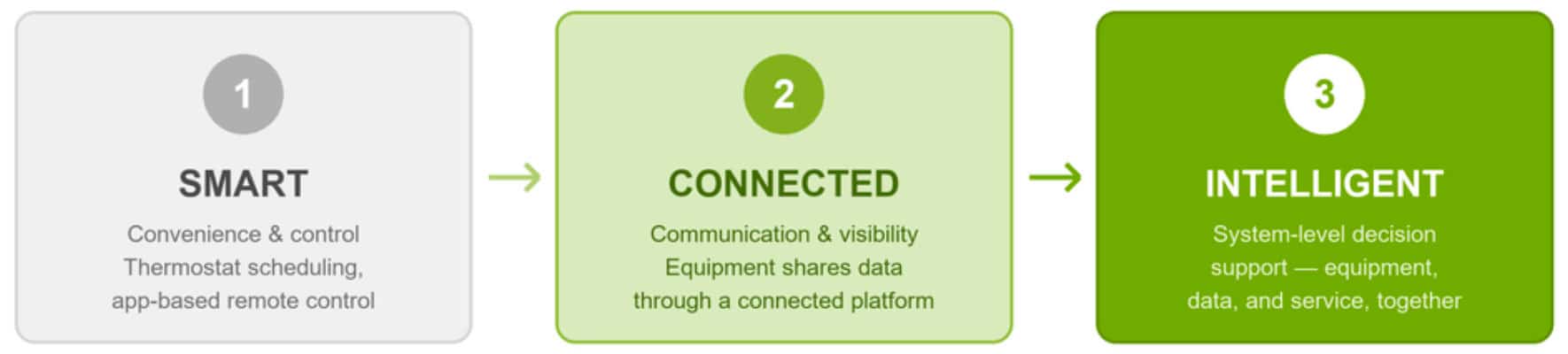
Table of Contents
- Smart vs. Connected vs. Intelligent: What’s Actually Different?
- Smart HVAC vs. Connected HVAC vs. Intelligent HVAC: Side-by-Side Comparison
- The Role of Variable-Speed and Inverter Technology
- How Monitoring and Diagnostics Change HVAC Service
- Ecoer’s Approach to Intelligent Comfort Technology
- What Should You Ask Before Choosing a System?
- Frequently Asked Questions
Smart vs. Connected vs. Intelligent: What’s Actually Different?
These terms get used interchangeably in HVAC marketing, but they describe different things — and none of them are official industry certifications. Manufacturers apply “smart,” “connected,” and “intelligent” inconsistently, so the label on a spec sheet matters less than what the system actually does.
Smart HVAC usually refers to a smart thermostat or app — remote temperature control, scheduling, geofencing, or usage notifications. Useful for convenience, but a thermostat can know the room temperature without having any visibility into what’s happening inside the equipment itself: compressor behavior, refrigerant conditions, or fault history.
Connected HVAC adds communication — equipment, sensors, and cloud platforms exchanging information instead of operating as isolated components. That can close the visibility gap between service visits, giving a technician more than a single snapshot taken during a house call. See Ecoer’s How IoT HVAC Monitoring Improves Long-Term Home Comfort for more on how this plays out in practice.
Intelligent HVAC goes further still. It combines adaptive equipment operation with connected monitoring, diagnostics, and service tools — not just a connected interface, but equipment that can sense, adjust, and communicate at the system level. That’s the distinction that actually shows up in day-to-day comfort: steadier temperatures, quieter operation, better humidity control, and service visits that start with more information instead of guesswork. For a deeper look at this approach, see Ecoer’s What Is Intelligent HVAC? How the Next Generation of Home Comfort Works.
COMMON MISTAKE
Do not assume that a Wi-Fi thermostat makes the entire HVAC system intelligent. The thermostat is an interface. The deeper question is what the heating and cooling equipment itself can sense, adjust, record, and communicate.
Smart HVAC vs. Connected HVAC vs. Intelligent HVAC: Side-by-Side Comparison
These categories can overlap — a single system may be both smart and connected, while Intelligent HVAC uses those capabilities as part of a broader system rather than the end goal.
| Capability | Smart HVAC | Connected HVAC | Intelligent HVAC |
|---|---|---|---|
| Primary purpose | Convenience and control | Communication and visibility | System-level performance and decision support |
| Typical homeowner experience | App control, scheduling, settings | Connected status and notifications | Simple comfort interface backed by broader system intelligence |
| Equipment-level data | May be limited | Can be available | Used as part of monitoring, diagnostics, and service |
| Equipment response | May be fixed, staged, or variable | Depends on equipment | Can combine adaptive or inverter-driven operation with connected information |
| Monitoring | Often thermostat-centered | Can include equipment monitoring | Equipment-level monitoring supports lifecycle visibility |
| Diagnostics | May be limited | Data and alerts may support evaluation | Diagnostic context supports more informed professional decisions |
| Installation support | Not required | Not required | Can include commissioning and setup tools that reduce variability |
| Long-term service | Often separate from smart controls | Connected data can support service | Connected information and professional tools remain part of the system approach |
The Role of Variable-Speed and Inverter Technology
Intelligence isn’t only about data — it’s also about how the equipment itself responds to changing conditions. Traditional single-stage systems run at full output whenever heating or cooling is called for, then shut off. Inverter-driven systems modulate output instead, which is what actually shows up as comfort: steadier indoor temperatures, quieter operation, and better humidity control, because the system isn’t just blasting air in short full-power bursts.
For a detailed comparison, see Ecoer’s Inverter Heat Pumps vs. Traditional HVAC Systems. The U.S. Department of Energy notes that inverter-driven heat pumps can modulate speed and capacity across a wide range to support efficient, consistent operation.
Source: U.S. Department of Energy — Heat Pumps.
How Monitoring and Diagnostics Change HVAC Service
Traditional service starts when a homeowner notices a problem, or at a scheduled visit. Connected monitoring gives a technician visibility into how the system has been operating between those visits — status, alerts, temperatures, runtime — so a service call can start with information instead of guesswork. That’s a real, if modest, promise: it can help a professional catch something worth attention sooner. It’s not a guarantee against every failure.
SERVICE PRINCIPLE
Remote diagnostics provide information, not remote repair. They can support earlier identification of conditions that deserve attention and help qualified professionals make more informed service decisions, but they do not guarantee that failures will be predicted or prevented.
Ecoer’s Approach to Intelligent Comfort Technology
Ecoer is an Intelligent Comfort Technology Company. The distinction that matters most: intelligence lives in the equipment itself, not just the thermostat. Inverter-driven systems adjust to real conditions, connected monitoring provides visibility into how the equipment is actually operating, and installation tools like Ecoer Automated Charging (EAC) help make sure the system is set up right from day one. Ecoer describes this as System Intelligence: the ability of Ecoer systems to use system data, connectivity, and technology to provide greater visibility, diagnostics, and control.
EAC also supports accurate refrigerant charging and commissioning. See Ecoer’s Why Refrigerant Charging Is One of the Biggest HVAC Installation Problems and ENERGY STAR’s HVAC Quality Installation guidance.
| Ecoer Technology Area | How It Supports Intelligent Comfort |
|---|---|
| Inverter-driven systems | Adjust capacity to changing heating and cooling demand rather than relying only on fixed full-output operation. |
| Ecoer Pulse / connected monitoring | Communicates equipment and diagnostic information through Ecoer’s connected service ecosystem. |
| ESS Pro | Provides qualified HVAC professionals with remote monitoring, historical data, alerts, diagnostics, registration, and technical resources. |
| Ecoer Automated Charging (EAC) | Supports refrigerant charging and commissioning on applicable Ecoer systems to help reduce installation variability; final charge and setup remain subject to qualified professional verification. |
| Smart thermostat and Ecoer Home | Give homeowners a simpler interface for comfort control while the broader system manages equipment operation and connectivity. |
ECOER PRINCIPLE
Technology should reduce variability—not increase complexity. Intelligent Comfort Technology should make installation more consistent, system operation more visible, diagnostics more informed, and long-term service better supported.
Official Ecoer resources: Ecoer Home & ESS Pro | HVAC Monitoring Module | Ecoer Automated Charging (EAC) | Monitoring & Thermostat Documents
What Should You Ask Before Choosing a System?
A few practical questions can reveal whether a system’s “smart” features are just convenience, or backed by real equipment-level intelligence:
- Does the equipment itself report data, or only the thermostat? Equipment-level visibility is one important distinction between basic smart controls and a more intelligent, system-level HVAC approach.
- Can a technician access current and historical system data? That’s what actually makes connected data useful for service.
- Does the equipment adjust output as conditions change? Adaptive operation is what drives steadier comfort and humidity control.
- How is the system commissioned and verified at install? Intelligent technology can’t fix a poorly installed system.
- Do contractors keep access to diagnostics after installation? Ongoing access separates a real service ecosystem from a one-time feature.
- Which of these capabilities apply to the exact model being quoted? Features vary — confirm specifics with the contractor or manufacturer.
Frequently Asked Questions
What makes HVAC “intelligent”?
Do I still need professional maintenance with Intelligent HVAC?
What does Ecoer mean by Intelligent Comfort Technology?
Find the Right System for Your Home
The difference between smart, connected, and Intelligent HVAC isn’t about which label sounds most advanced — it’s about how much of the system actually works together on your behalf. If you’re ready to see what Intelligent Comfort Technology looks like in a real system, explore Ecoer’s heat pump and AC systems, or find an Ecoer dealer near you to talk through what’s right for your home.
