

QUICK ANSWER
Inverter HVAC technology uses an electronic drive to change how fast a heat pump or air conditioner’s compressor runs, so the system can raise or lower its output instead of operating only at full power or not at all. By matching output to what the home needs at that moment, an inverter-driven system can deliver steadier temperatures, quieter operation, and strong everyday efficiency—when it is properly sized, installed, and commissioned. The real question isn’t just whether a system has an inverter. It’s how much of the system adapts, and how well it’s installed.
Table of Contents
- What Is Inverter HVAC Technology?
- How an Inverter System Works
- Single-Stage vs. Two-Stage vs. Inverter-Driven Systems
- Why Inverter Technology Changes Home Comfort
- Why Installation and Commissioning Matter
- Ecoer’s Inverter-Driven Approach
- What Should You Ask Before Choosing a System?
- Frequently Asked Questions
What Is Inverter HVAC Technology?
Definition: Inverter HVAC technology is the use of an electronic drive to control the speed of a heat pump or air conditioner’s motors—most importantly the compressor—so heating and cooling output can rise and fall with demand.
“Inverter” and “variable-speed” are often used interchangeably. The inverter is the electronic drive, and variable-speed describes what the equipment can do as a result. Neither is a certification, and manufacturers implement them differently. Some systems adjust only the compressor. Others also vary the indoor blower and outdoor fan and use an electronically controlled expansion valve. The specifications matter more than the label.
COMMON MISTAKE
Do not assume that “inverter” means “intelligent.” Inverter technology makes HVAC adaptive, but it does not make the system intelligent by itself. It provides the operating foundation. Intelligent HVAC builds on that foundation through connectivity, monitoring, diagnostics, installation support, and professional service tools. What Is Intelligent HVAC? explains the full approach.
How an Inverter System Works
Inside the outdoor unit, an inverter-driven compressor follows a continuous loop:
| SENSE | DECIDE | CONVERT | DRIVE | BALANCE |
|---|---|---|---|---|
| Sensors and the thermostat show how much heating or cooling is needed | The control board selects a target compressor speed | The inverter turns incoming power into variable-frequency power | The compressor motor speeds up or slows down | Fans and the expansion valve adjust to match the new output |
Matching output to demand. The control board runs a continuous feedback loop. It compares the indoor temperature with the setpoint, and how quickly that temperature is moving, to choose a target compressor speed. A large gap calls for higher speed. As the gap closes, the board ramps the compressor down and settles near the speed that holds the temperature steady, rather than overshooting and shutting off. When conditions change, such as afternoon sun load or a door left open, the board adjusts the target again.
Compressor speed follows frequency. The inverter converts incoming alternating current to direct current, then rebuilds it as alternating current at the frequency the control board requests. A lower frequency turns the compressor more slowly and a higher frequency turns it faster, so capacity follows speed. Because the compressor ramps up gradually instead of starting at full speed, inverter systems also tend to avoid the abrupt surge and sudden sound of a full-speed start.
The rest of the system follows the compressor. As compressor speed changes, refrigerant flow, airflow, and pressures all have to change with it. The electronically controlled expansion valve adjusts refrigerant metering, the indoor blower adjusts airflow to suit the new capacity, and the outdoor fan adjusts to keep refrigerant pressures in range. Sensors on temperatures, pressures, and on many designs motor current keep the compressor within safe operating limits. This coordination is what turns a variable-speed compressor into a variable-capacity system.
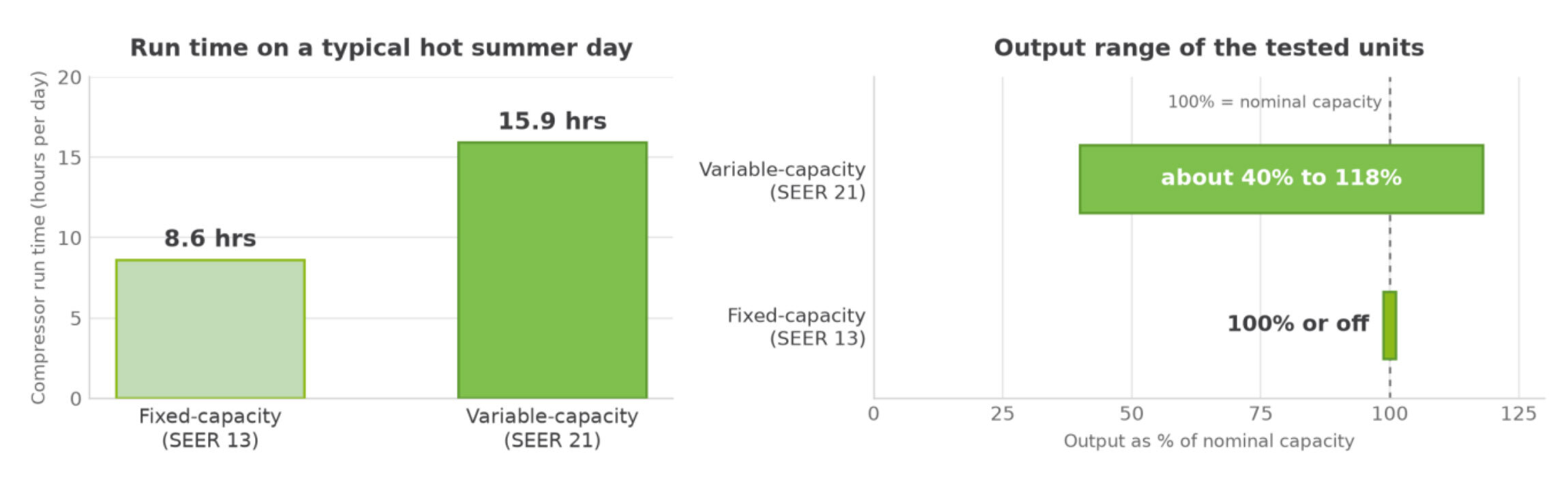
Why that produces steadier comfort. A single-stage system can only correct in large steps: it runs at full output until the temperature crosses a threshold, then stops until it drifts back. An inverter-driven system corrects in small steps, so indoor temperature stays closer to the setpoint, air is typically delivered more gently and over longer periods, and the coil spends more time cold enough to remove moisture. A U.S. Department of Energy Building America field study shows the result. The variable-capacity heat pumps it tested modulated between roughly 40% and 118% of nominal capacity and stayed on for about 60% to 100% more hours per day than comparable fixed-capacity units. Ranges differ by product, but the pattern is the point: lower, longer, gentler operation instead of short bursts at full power. Read the Building America study.
Single-Stage vs. Two-Stage vs. Inverter-Driven Systems
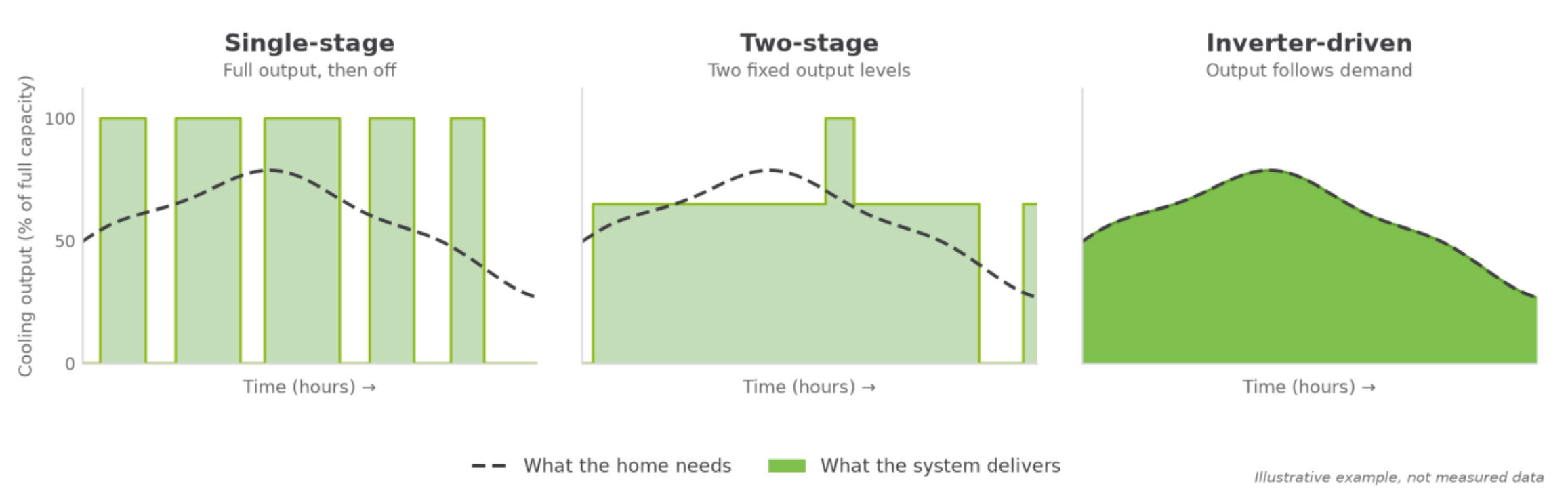
Not every efficient system modulates the same way. In each panel below, the dashed line is what the home needs and the green area is what the system delivers.
| Characteristic | Single-Stage | Two-Stage | Inverter-Driven |
|---|---|---|---|
| Compressor operation | One speed: full output or off | Two fixed levels: lower and high | Continuously adjustable within a range |
| Matching demand | Cycles on and off | Runs mostly on the lower stage | Adjusts output in small increments |
| Temperature stability | Larger swings between cycles | Reduced swings | Typically the smallest swings |
| Sound | Full-speed starts and stops | Quieter on the lower stage | Can run at low speed, with gradual starts |
| Part-load efficiency | Typically the lowest of the three | Typically higher | Typically the strongest |
These descriptions reflect typical designs, and individual products vary. For a contractor-focused comparison, see Ecoer’s Inverter Heat Pumps vs. Traditional HVAC Systems.
Why Inverter Technology Changes Home Comfort
Homeowners do not experience frequency or compressor speed. They experience the result:
- Steadier temperatures. With output matched to demand, the system tends to run longer at lower output instead of cycling between extremes, which reduces swings around the thermostat setting.
- Quieter operation. Running at lower speed is generally quieter than repeated full-speed cycles. Sound levels still vary by model.
- Better humidity management. Longer, lower-speed runs give the coil more time to remove moisture, but airflow and control settings decide the result. The Building America study found humidity outcomes varied with control strategy. See Dehumidification Explained for how Ecoer approaches it.
- Efficiency where homes spend most of their time. Homes rarely need maximum output, and SEER2 and HSPF2 ratings measure performance across a season rather than at one peak point. The Building America researchers observed that variable-capacity systems operate at a much higher efficiency at their lowest capacity. Ducts, airflow, and settings still shape what a home actually experiences.
DID YOU KNOW?
A system that seems to be “always on” may simply be doing its job. A long, quiet, low-speed run is normal operation for variable-capacity equipment.
Why Installation and Commissioning Matter
Inverter-driven equipment can adjust its speed, but it cannot correct a system that is oversized, short on airflow, or incorrectly charged. ENERGY STAR identifies proper sizing, airflow, refrigerant charge, and duct performance as core elements of HVAC quality installation. Ecoer discusses why charging deserves particular attention in Why Refrigerant Charging Is One of the Biggest HVAC Installation Problems.
Ecoer’s Inverter-Driven Approach
Inverter technology is available from many HVAC manufacturers. For Ecoer, the inverter is not the complete technology story—it is the adaptive foundation of Intelligent Comfort Technology. The difference is what is built around it: installation support, connected system visibility, diagnostics, and professional service tools working together throughout the system lifecycle. Smart HVAC vs. Connected HVAC vs. Intelligent HVAC explains how this system-level approach differs from basic smart or connected features.
Ecoer systems continuously adjust output to changing conditions in the home. Because modulation depends on the compressor, expansion valve, fans, and sensors working together, accurate setup matters. Ecoer Automated Charging (EAC) helps contractors achieve accurate refrigerant charging during system setup, reducing one important source of installation variability. After installation, Ecoer Pulse connected monitoring makes operating information such as temperatures, pressures, and runtime visible to professionals to support diagnostics and more informed service decisions. Together, they show how Ecoer aims to make comfort easier to install, service, and own.
| Ecoer Technology Area | How It Supports Inverter-Driven Comfort |
|---|---|
| Inverter-driven systems (TDi Select 2, TDi Pro 2) | Adjust output continuously to what the home needs, supporting steadier temperatures and quieter operation. |
| Ecoer Pulse / connected monitoring | Communicates equipment and diagnostic information through Ecoer’s connected service ecosystem. |
| Ecoer Automated Charging (EAC) | On applicable systems, helps contractors achieve accurate refrigerant charging during system setup, reducing one important source of installation variability. |
The TDi Select 2 inverter heat pump system received Honorable Mention in the Residential Product category of the 2026 HVAC All-Star Awards from ACHR News. Read more in Ecoer TDi Select 2 Inverter Heat Pump Earns 2026 HVAC All-Star Recognition.
ECOER PRINCIPLE
Complexity should live inside the system—not in the homeowner experience. For Ecoer, inverter technology is valuable not because it makes HVAC more complicated, but because it allows the system to adapt more precisely while making comfort feel simpler. The more sophisticated the technology becomes, the less the homeowner should have to think about HVAC.
What Should You Ask Before Choosing a System?
A few practical questions can reveal whether “inverter” on a spec sheet reflects real capability:
- How low and how high can the compressor go? The capacity range shows how closely the system can match everyday demand.
- Do the indoor blower and outdoor fan also vary their speed? Fan speed affects sound, air movement, and moisture removal.
- How will the contractor size the system and verify airflow and refrigerant charge? Inverter technology performs best when the fundamentals are correct.
- How does the system manage humidity? Ask what dehumidification features exist and how airflow will be set for your home.
- What is the heating capacity at low outdoor temperatures? For cold winters, published low-temperature capacity says more than the word “inverter.”
- What support exists for commissioning and service after installation? Confirm which capabilities apply to the exact model being quoted.
Frequently Asked Questions
What is inverter HVAC technology?
Is inverter HVAC the same as Intelligent HVAC?
How does an inverter match output to demand?
Is an inverter-driven system more efficient?
Do inverter systems work in cold weather?
Why does my inverter system seem to run all the time?
What makes Ecoer’s approach to inverter technology different?
Find the Right System for Your Home
The value of inverter technology isn’t the label—it’s how much of the system adapts on your behalf.
Continue Learning: Learn how connected HVAC monitoring adds visibility to inverter-driven systems.
Explore Ecoer: Explore Ecoer’s inverter heat pump and AC systems.
