

QUICK ANSWER
Real-time HVAC diagnostics use equipment data, fault alerts, and operating history to help HVAC professionals identify unusual conditions and potential problems. While remote monitoring shows how a system is operating, diagnostics help interpret that information to support more informed troubleshooting and service decisions. This can help professionals identify certain issues earlier, although it cannot predict or prevent every equipment failure.
Table of Contents
- What Are Real-Time HVAC Diagnostics?
- Monitoring vs. Diagnostics: What’s the Difference?
- How Ecoer’s Connected Diagnostics Work
- What Problems Can Ecoer’s Diagnostics Help Identify?
- Why Identifying HVAC Problems Earlier Matters
- Reactive Service vs. Diagnostics-Informed Service
- Why Included Monitoring Matters for Diagnostics
- How Ecoer Brings It All Together
- What Real-Time Diagnostics Can’t Do
- Frequently Asked Questions
What Are Real-Time HVAC Diagnostics?
Real-time HVAC diagnostics use equipment data to help identify problems while a heating or cooling system is operating. Instead of waiting until something breaks, the technology monitors conditions such as temperature, pressure, and system performance to detect unusual changes.
For example, if a system begins operating outside its expected range, diagnostic technology may flag the issue so an HVAC professional can investigate.
The goal isn’t to replace a technician. It’s to give them better information to help identify problems and make more informed service decisions.
Researchers at Pacific Northwest National Laboratory (PNNL) describe the same idea in their work on automated fault detection and diagnostics: tools that monitor data such as temperatures, pressures, and control signals in real time and apply rules to identify faults and their likely causes.
Monitoring vs. Diagnostics: What’s the Difference?
Monitoring and diagnostics work together, but they serve different purposes. Monitoring collects information about how an HVAC system is operating. Diagnostics analyze that information to identify unusual conditions and potential problems.
Think of monitoring as showing what’s happening inside the system, while diagnostics help explain what those readings might mean. What Is HVAC Remote Monitoring? covers the monitoring side in more detail.
| Monitoring | Diagnostics | |
|---|---|---|
| Purpose | Tracks system performance | Identifies potential problems |
| Information | Operating data and history | Fault alerts and possible causes |
How Ecoer’s Connected Diagnostics Work
Ecoer’s connected diagnostics have three parts:
| 1. ECOER PULSE | 2. ECOER SMART SERVICE | 3. ESS PRO |
|---|---|---|
| Collects and transmits operating data | Processes the information | Contractors review alerts and history |
Ecoer Pulse collects and transmits data. The Ecoer Pulse HVAC Monitoring Module sends operating information from compatible Ecoer equipment.
Ecoer Smart Service (ESS) processes the information. Ecoer’s monitoring platform supports system analysis and diagnostic alerts. It also provides service recommendations for potential faults, including components or parts that may be involved, as a starting point for the technician’s evaluation.
Contractors use the ESS Pro App. In the ESS Pro App, HVAC professionals review alerts, check operating history, and troubleshoot potential issues.
Homeowners use the Ecoer Home+ App, which shows system status and comfort controls. The technical detail goes to the professional who can act on it.
ECOER ADVANTAGE
Better prepared before the visit. With Ecoer Pulse and the ESS Pro App, contractors can review diagnostic alerts, system conditions, and operating history before they arrive. Service recommendations from ESS, including components or parts a potential fault may involve, help them plan the visit. The technician still confirms the cause on site and decides on the right repair.
What Problems Can Ecoer’s Diagnostics Help Identify?
Ecoer’s connected diagnostics can help HVAC professionals recognize certain problems that may affect system performance, depending on the equipment and configuration. Examples include:
- Refrigerant issues: operating conditions that may indicate a refrigerant level that is too high or too low, or a potential leak.
- Filter issues: conditions that may indicate a filter that needs cleaning or replacement.
- Equipment faults: alerts when a system or component experiences a malfunction.
Some problems develop gradually, while others happen suddenly. Diagnostic alerts help contractors understand what may be happening so they can decide on the right next steps.
Why Identifying HVAC Problems Earlier Matters
Not every HVAC problem causes an immediate breakdown. A system may keep heating or cooling while using more energy or operating less efficiently. For example, low refrigerant or restricted airflow can affect performance long before a homeowner realizes something is wrong. Ecoer looks at how that happens in What Causes HVAC System Failures?
A National Institute of Standards and Technology (NIST) study shows how much this can matter. It simulated heat pumps with common faults across several U.S. climates. A 30% refrigerant undercharge raised annual energy use by roughly 17% to 23%, and low indoor airflow and refrigerant overcharge also caused double-digit increases.
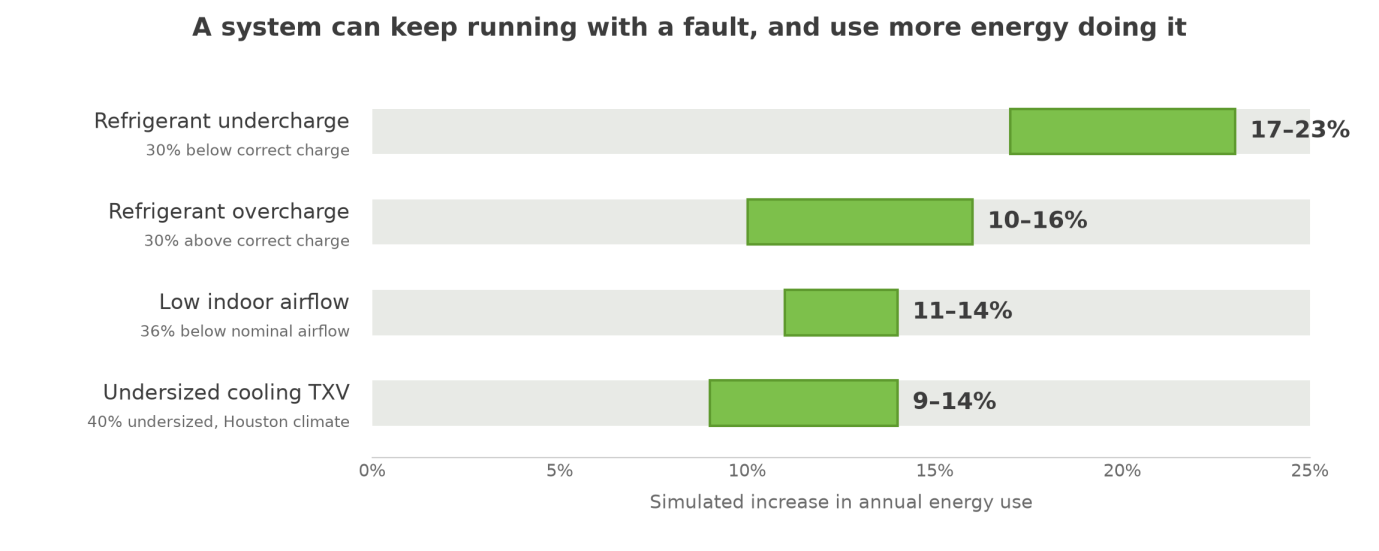
These simulated figures illustrate why HVAC faults matter. They are not measured energy savings, and they do not describe the fault-detection performance of Ecoer systems.
The NIST figures come from installation faults, but some of the same conditions can develop over time. A slow refrigerant leak gradually lowers the charge, and a clogged filter reduces airflow. The same PNNL analysis notes that sending real-time data to a designated HVAC contractor reduces the potential for faults to go undetected.
Identifying these conditions earlier gives contractors an opportunity to investigate and recommend service before the problem becomes more serious. The graph below shows the idea.

“Earlier” means earlier than the problem would otherwise come to light, usually when the house stops feeling comfortable. It does not mean diagnostics can predict every failure. A component can fail suddenly, and in that case an alert reports a failure rather than predicting one.
DID YOU KNOW?
A reading only means something in context. A high compressor speed on the hottest afternoon of the year may be normal. The same reading on a mild morning may not be. Operating history helps a technician tell the difference, especially on inverter-driven systems whose speeds change all day, as explained in How Inverter HVAC Technology Works.
Reactive Service vs. Diagnostics-Informed Service
HVAC service often begins when a homeowner notices a problem and calls a contractor. Real-time diagnostics provide another way to identify potential issues by giving HVAC professionals access to equipment alerts and operating history. Ecoer Pulse supports 24/7 system monitoring when the monitoring service and connectivity are active. Not every developing problem will show up early in the data, so the data supports a technician’s evaluation rather than replacing it.
This information can help contractors investigate developing problems, prepare for service visits, and make more informed maintenance recommendations.
| Reactive Service | Diagnostics-Informed Service | |
|---|---|---|
| What starts it | A comfort problem or breakdown the homeowner notices | An alert or a trend in the system’s data |
| What the technician knows on arrival | What the homeowner describes | System conditions, fault alerts, and operating history |
| When the issue is addressed | After it shows up in the home | Potentially sooner, when the data shows a developing issue |
For contractors, the performance history in the ESS Pro App adds three benefits:
- Identifying trends. ESS Pro shows how a system has operated over time, not only how it is running now, so a reading that shifts slowly over weeks is easier to see.
- Preparing for service calls. Contractors can review system conditions, diagnostic alerts, and performance data before arriving. Service recommendations from ESS, including components or parts a potential fault may involve, help them plan the visit and make more informed decisions.
- Maintaining customer relationships. Alerts and operating history give contractors a natural reason to stay in touch with homeowners between visits.
Why Included Monitoring Matters for Diagnostics
Diagnostics depend on an active monitoring service. Many eligible Ecoer systems include the first three years of monitoring, so contractors can receive diagnostic alerts and build operating history from the start, and homeowners gain peace of mind knowing their HVAC professional can stay informed.
Included coverage and paid upgrade options depend on the outdoor unit model. Monitoring requires a compatible monitoring module, system registration, and an active connection. The Extended Services page lists current coverage by model, and What Is HVAC Remote Monitoring? explains the monitoring service in more detail.
How Ecoer Brings It All Together
Ecoer combines inverter-driven technology, connected monitoring, and professional diagnostic tools to support system performance throughout the equipment’s life. These technologies work together to give contractors more information about how equipment operates, helping them troubleshoot issues and provide informed service. What Is Intelligent HVAC? explains the full approach.
ECOER PRINCIPLE
Data alone does not improve HVAC service. Its value comes from turning system information into insights that help professionals make better decisions.
For Ecoer, connected diagnostics bridge the gap between system visibility and informed professional service, helping contractors understand potential issues and determine the appropriate next steps.
What Real-Time Diagnostics Can’t Do
Connected diagnostics provide valuable information, but they cannot predict every equipment failure or replace professional maintenance and correct installation. Some problems develop without warning, and a diagnostic alert does not automatically mean a repair is needed. A qualified HVAC professional must evaluate the information, confirm the cause, and determine the right solution.
Frequently Asked Questions
What are real-time HVAC diagnostics?
How are diagnostics different from remote monitoring?
What types of problems can Ecoer diagnostics identify?
How does the ESS Pro App help HVAC contractors?
Can real-time diagnostics prevent HVAC breakdowns?
Which Ecoer systems include monitoring?
Smarter Diagnostics. More Informed Service.
Ecoer’s connected monitoring and diagnostic technology helps HVAC professionals identify potential problems earlier, troubleshoot with more context, and make informed service decisions.
Continue Learning: See how the data behind diagnostics is collected in What Is HVAC Remote Monitoring?
Explore Ecoer Technology: Discover how Ecoer’s heat pump and AC systems combine innovative technology with professional service tools to support contractors and homeowners.
