
QUICK ANSWER
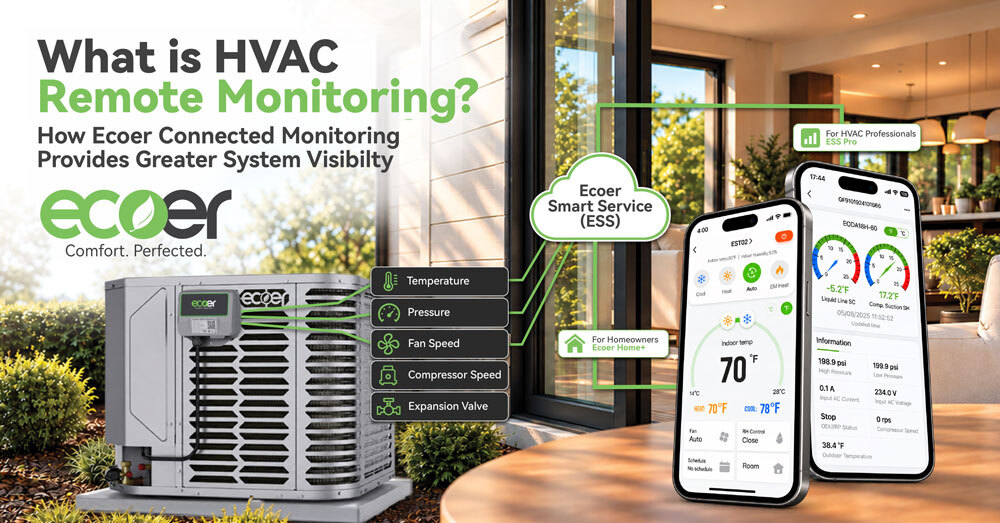
HVAC remote monitoring collects operating information from heating and cooling equipment—such as temperatures, pressures, and fan and compressor speed—and sends it over a connected service so authorized people can view it without being at the equipment. Ecoer builds this into its systems with the Ecoer HVAC Monitoring Module and Ecoer Smart Service (ESS). HVAC professionals see equipment readings and alerts in ESS Pro, and homeowners see system status and comfort controls in Ecoer Home+. Monitoring adds visibility. It does not repair equipment or replace professional installation and maintenance.
Table of Contents
- What Is HVAC Remote Monitoring?
- How Ecoer Remote Monitoring Works, Step by Step
- What Ecoer’s Monitoring Shows
- What Ecoer Adds on Top of the Data
- From Reactive Service to Proactive Maintenance
- Monitoring Included With Your System
- Built Into the System, Not Added On
- Why System Visibility Matters
- What Remote Monitoring Is Not
- Data, Privacy, and Security: What to Ask
- What Sets Ecoer’s Monitoring Apart
- Frequently Asked Questions
What Is HVAC Remote Monitoring?
Definition: HVAC remote monitoring is the collection, communication, and observation of heating and cooling system data through a connected device, so authorized homeowners or professionals can see how the equipment is operating without being on site.
Three ideas sit inside that definition. Collection: sensors and the equipment’s control board measure what is happening inside the system. Communication: a connected module sends that information over a network. Observation: someone with permission views it, usually in an app, as a current reading or as history.
Remote monitoring is about seeing the data. Interpreting that data to draw conclusions about performance is a separate step, usually called diagnostics, and it builds on monitoring rather than replacing it. Ecoer explores how monitoring supports service between visits in How IoT HVAC Monitoring Improves Long-Term Home Comfort. A connected thermostat is not the same thing; Smart HVAC vs. Connected HVAC vs. Intelligent HVAC explains the difference.
How Ecoer Remote Monitoring Works, Step by Step
Ecoer’s monitoring follows the same short path as any connected system:
| SENSE | COLLECT | COMMUNICATE | STORE | OBSERVE |
|---|---|---|---|---|
| Ecoer equipment measures its own operating conditions | The Ecoer HVAC Monitoring Module gathers the readings | Readings are sent to Ecoer Smart Service (ESS) | ESS keeps real-time and historic data | Professionals use ESS Pro; homeowners use Ecoer Home+ |
Communicate and store. The module sends those readings to Ecoer Smart Service (ESS), Ecoer’s monitoring platform, which keeps real-time and historic data. The monitoring service runs on a 4G network. Stored data is what makes history possible.
Observe. Access is role-based. Professionals use ESS Pro, which brings system data, fault alerts, and remote troubleshooting tools together in one app. Homeowners use Ecoer Home+ to view system status, adjust temperature, and manage comfort schedules through compatible connected controls.
What Ecoer’s Monitoring Shows
ESS Pro monitors the equipment 24/7 and provides real-time operating data and system operating history.
The readings include:
- Motor speeds: compressor speed and fan speed, which change continuously on an inverter-driven system.
- Expansion valve opening: how far the electronic expansion valve is open.
- Capacity, pressure, and temperature: the system’s output and status readings from inside the equipment.
- System status and faults: whether the system is operating normally, and any fault the equipment reports.
- History: a record over time, so today’s readings can be compared with earlier ones.
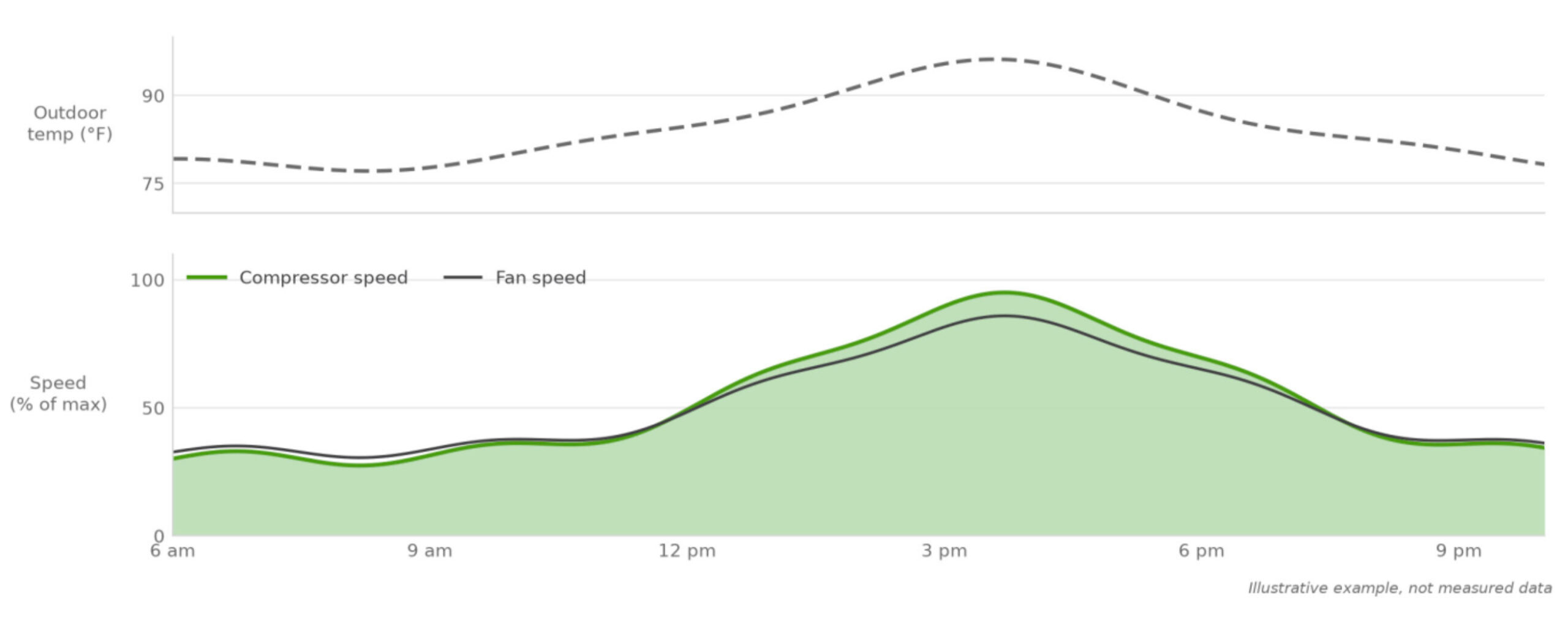
The graph below illustrates what that history can look like for an inverter-driven system on a hot day. Compressor and fan speed rise and fall with demand instead of switching between full speed and off, the adaptive operation described in How Inverter HVAC Technology Works.
What Ecoer Adds on Top of the Data
Ecoer’s platform does more than display readings. The HVAC Monitoring Module sends automatic alerts when a refrigerant level is too high or low, a filter needs attention, or a system or component fails, and ESS Pro offers remote troubleshooting tools and service recommendations. Those alerts build on the monitoring data.
Ecoer gives each person a separate view:
| Who | Tool | What It Offers |
|---|---|---|
| HVAC professional | ESS Pro | 24/7 remote monitoring, real-time data, operating history, automatic fault alerts, remote troubleshooting, and equipment registration |
| Homeowner | Ecoer Home+ | System status, temperature adjustment, and comfort schedules through compatible connected controls |
| Homeowner, at home | Ecoer smart thermostat | Room temperature, schedules, and filter-change reminders. A thermostat controls comfort. It does not report equipment readings. |
From Reactive Service to Proactive Maintenance
Traditional HVAC service is reactive. A comfort problem appears, someone calls, and a technician arrives to find the cause. Ecoer’s monitoring supports a more proactive approach. Ecoer Pulse connected monitoring keeps watch on system performance around the clock, and automatic alerts can flag a developing issue, such as a refrigerant level out of range or a filter that needs attention, so it can be addressed sooner and before it grows into a larger problem.
The performance history in ESS Pro matters just as much. It shows contractors how a system has operated over time, not only how it is running now, so they can spot trends, troubleshoot with context, and make more informed service decisions. Technicians can also review system conditions, alerts, and performance data before they arrive on site.
Monitoring Included With Your System
Monitoring service is included with Ecoer systems: ten years with the TDi Pro 2, and the first three years with the TDi Select 2 and TDi Elan. For contractors, that means visibility into the systems they install from the first day, with operating history and alerts available for service planning and a natural reason to stay in touch with the homeowner. For homeowners, it means the system is watched in the background from the start, which supports greater peace of mind without giving them anything extra to manage. TDi Select 2 and TDi Elan systems can extend monitoring to seven or ten years for a fee, and the monitoring service page has current details.
Built Into the System, Not Added On
For Ecoer, monitoring is one layer of Intelligent Comfort Technology, not a stand-alone feature. Inverter technology lets the equipment adapt, Ecoer Automated Charging (EAC) supports accurate setup, and Ecoer Pulse connected monitoring makes the operating system visible to the professionals who service it. Because the monitoring is built around inverter-driven systems such as the TDi Select 2 and TDi Pro 2, speed changes are part of the record. What Is Intelligent HVAC? explains how the pieces fit together.
DID YOU KNOW?
Monitoring starts to matter on day one. Readings taken at startup give a professional a baseline to compare against later, which is one reason correct setup, including accurate refrigerant charging, still matters. See Why Refrigerant Charging Is One of the Biggest HVAC Installation Problems.
Why System Visibility Matters
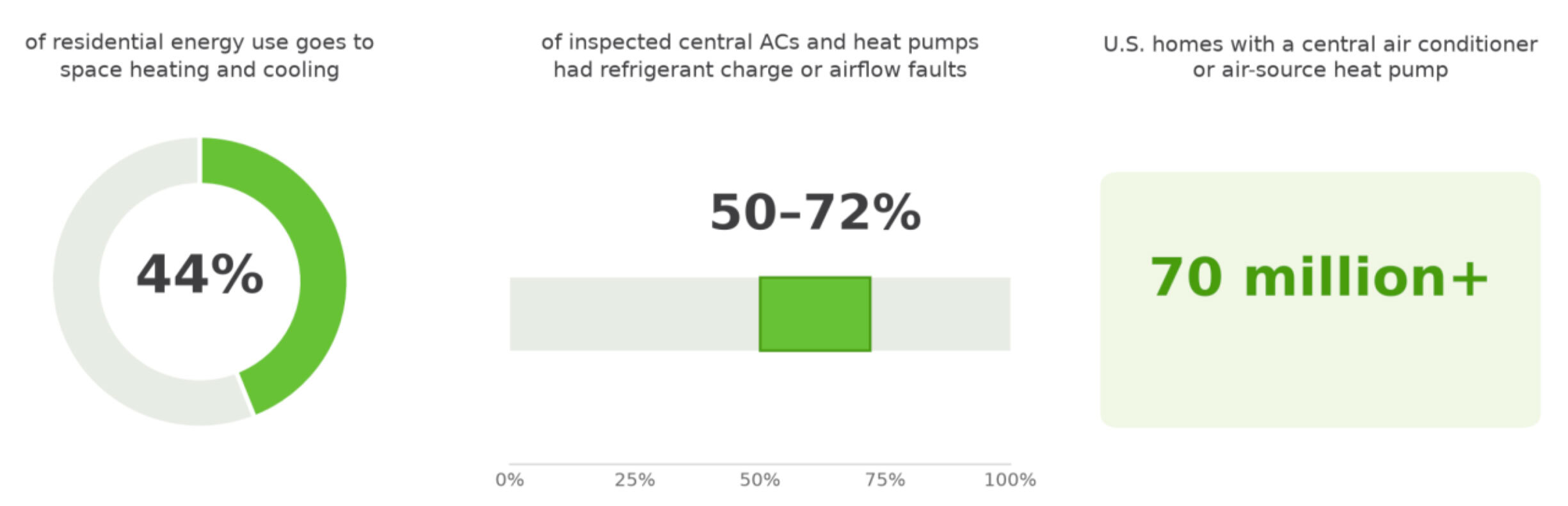
Between service visits, a traditional HVAC system is largely out of sight. The stakes are real: heating and cooling account for 44% of residential energy use, and central air conditioners and heat pumps are installed in more than 70 million U.S. homes, according to PNNL’s residential market analysis.
That report also cites field studies that found inadequate refrigerant charge or insufficient evaporator airflow in 50% to 72% of the central air conditioners and heat pumps inspected. Monitoring does not fix those conditions. It makes operating information visible, so performance can be observed instead of assumed.
What Remote Monitoring Is Not
- Not remote repair. Monitoring shows information. It does not change how the equipment runs.
- Not a substitute for quality installation or maintenance. A well-monitored system that is poorly installed is still poorly installed.
- Not a guarantee. Data can help a professional see more, but it does not prevent every problem.
- Not a replacement for a professional. Alerts and readings inform a technician’s judgment. They do not replace it.
Data, Privacy, and Security: What to Ask
A connected system sends equipment data over a network. A few questions are worth asking your dealer, whichever brand you consider:
- Who can see my data, and can I control access? The contractor, the manufacturer, and family members may have different levels of access.
- How does it connect? Ask whether it uses Wi-Fi, a wired connection, or cellular, and whether it needs your home network password.
- Does the manufacturer publish security information? The FCC is developing a voluntary U.S. Cyber Trust Mark label for consumer connected products to make that information easier to find.
What Sets Ecoer’s Monitoring Apart
Many HVAC manufacturers offer remote monitoring. The differences are in what it reads, how it connects to installation and operation, and how it is supported. Four questions help compare any system, and the table shows how Ecoer approaches each one.
| Question to Ask | What to Look For | How Ecoer Approaches It |
|---|---|---|
| What does it read? | Readings from inside the equipment, not just the room | Compressor speed, fan speed, expansion valve opening, capacity, pressure, and temperature, monitored 24/7 through ESS Pro. |
| Is it tied to installation? | Monitoring that starts from a verified setup | Ecoer Automated Charging (EAC), on applicable systems, supports accurate refrigerant charging during setup. |
| Does it fit how the equipment operates? | Visibility into adaptive operation | It is built around inverter-driven systems such as the TDi Select 2 and TDi Pro 2, so speed changes are part of the record. |
| What does it cost to keep running? | A defined service term and any ongoing fees | Ten years included on the TDi Pro 2. Three years included on the TDi Select 2 and TDi Elan, extendable for a fee. |
ECOER PRINCIPLE
Complexity should live inside the system—not in the homeowner experience. For Ecoer, remote monitoring is valuable not because it gives homeowners more data to manage, but because it gives the professionals who support the system greater visibility while comfort stays simple. The more sophisticated the technology becomes, the less the homeowner should have to think about HVAC.
Frequently Asked Questions
What is HVAC remote monitoring?
How does Ecoer remote monitoring work?
What is Ecoer Smart Service (ESS)?
What data does Ecoer’s monitoring show?
What is the difference between ESS Pro and Ecoer Home+?
How does Ecoer monitoring support proactive maintenance?
Does remote monitoring replace professional maintenance?
How long is monitoring included with an Ecoer system?
Is my data secure?
What makes Ecoer’s approach to monitoring different?
Find the Right System for Your Home
Remote monitoring is most valuable when it works alongside quality equipment, accurate installation, and professional service.
Continue Learning: See how connected monitoring fits the full picture in What Is Intelligent HVAC?.
Explore Ecoer: Explore Ecoer’s heat pump and AC systems.
